

How Three Decisions You Never Made Are Running (and Ruining)
Your Online Business
What would you do if you woke up tomorrow and your entire online business was gone?
Not hacked. Not deleted. Just… inaccessible.
The platform changed its terms. Or your account got flagged. Or the algorithm shifted overnight and your reach dropped to zero. Or the tool you built everything on got acquired, pivoted, or shut down.
I know exactly what that feels like.
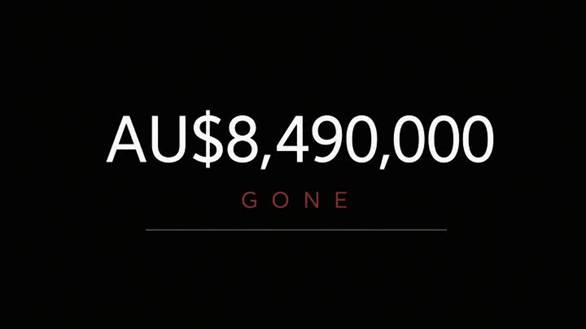
Because in 2022, I watched AU$8.49 million in business value disappear. Not slowly. Overnight.
And the worst part? I had done everything right.
Maybe you’re building something right now.
A course. A membership. A coaching practice. A digital product. An audience.
You’re showing up on social. You’re creating content. You’re learning the tools, the funnels, the platforms.
And somewhere in the back of your mind, there’s a quiet question you haven’t fully answered yet:
If the platform disappeared tomorrow, what exactly would I have left?
Most people push that question down. It’s uncomfortable. There’s always something more urgent to do.
But that question is the most important business question you will ever ask yourself.
And the answer depends entirely on three decisions.
Decisions most online business owners have never consciously made.
By the time you finish reading this, you’ll know:
1. Why most online businesses are one platform decision away from losing everything
2. The three decisions that determine whether your business is truly yours or just borrowed from a platform
3. What to do right now to start building something that cannot be taken from you
This is not theory. This is the system I built after losing AU$8.49 million, so it would never happen again.
My name is Leo.
I’ve spent over 20 years in education, business, and online marketing. I’ve built courses, memberships, communities, coaching programs, and digital products across multiple niches.
I’ve helped thousands of people build and grow their own online businesses.
And I got caught in the exact trap I’m going to tell you about.
That’s why I’m the right person to explain it.
Not because I have a perfect track record. Because I made every mistake, paid the price in full, and rebuilt with the lessons that actually matter.

Hey friend, my name is Leo.
Here’s what happened.
For years, I built what looked like a thriving business. Revenue was growing. The audience was engaged. The systems were working.
But almost everything I had built was sitting on top of other people’s infrastructure.
My content lived on their platforms. My audience was on their lists. My delivery tools were their software. My revenue depended on their algorithms and their terms of service.
I thought I was building a business. I was actually building on rented land.
In 2022, the ground shifted.
The total value of what I lost, across revenue, audience, and business equity, was AU$8.49 million.
I remember the exact moment I realised what had happened.
It wasn’t dramatic. There was no single phone call or email. It was just me, sitting at my desk, running the numbers, and slowly understanding that a significant portion of everything I had built was gone.
The business I thought I owned? I had been a tenant the entire time.
That experience changed everything about how I think about online business.
I spent the next two years reverse-engineering what had gone wrong. Not just what happened to me, but what I was seeing happen to business owners everywhere.
Coaches who built their entire business on one social platform. Course creators whose delivery tools got shut down. Community builders whose groups got unpublished. Membership site owners locked out of their own content.
The details were different. The pattern was identical.
Every single one of them had made the same three decisions without realising it.
Or more accurately: they had never made those decisions at all. The platform had made the decisions for them.
Once I could see the pattern, I could build the solution.
I call it The Ownership Stack.
And it starts with understanding the three decisions every digital business owner needs to make deliberately, before the platform makes them by default.
Here is what most online business owners are doing right now.
They’re working hard. Creating content. Running ads. Building funnels. Selling products.
But underneath all of that activity, they’re sitting on three unresolved questions:
Where does my business actually live?
What framework is holding my business together?
If I stopped tomorrow, could I sell what I’ve built?
If you can’t answer those three questions with confidence, you don’t own your business.
You’re managing it. On someone else’s terms.
The platform owns the audience. The software company owns the delivery. The algorithm owns the reach. The terms of service own the rules.
And you own… the effort you put in.
That’s not a business. That’s a very stressful job working for a platform that doesn’t pay you a salary.
This is not a niche problem.
In the last five years, I have watched platforms change their algorithms without notice, delete accounts without appeal, remove features that entire businesses were built on, and change their pricing models in ways that made previously profitable businesses unprofitable overnight.
Facebook organic reach collapsed. YouTube monetisation rules changed. Email providers updated their deliverability standards. Course platforms got acquired. Community tools pivoted. Payment processors froze accounts.
Every single time, the people who got hit hardest were the ones who had built on one thing, in one place, without a foundation of their own.
The people who were fine? They had made the three decisions.
They knew where their business actually lived. They owned the infrastructure. And they had built something that could survive a platform shift, because it did not depend on one.
The difference between those two groups is not luck, budget, or technical skill.
It’s three decisions.
The Ownership Stack is the system I built to make sure what happened to me could never happen again.
It is built on three decisions. In order. Each one depends on the last.
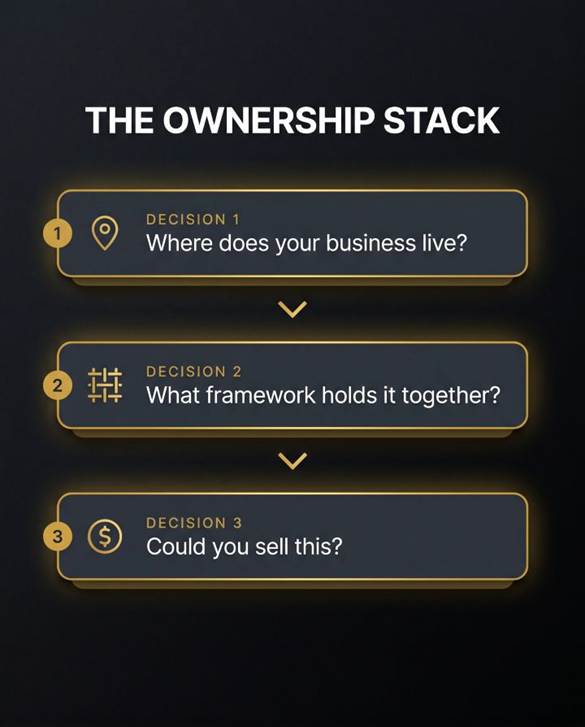
Decision 1: Where does your business live?
Not your social media. Not your content. Your business. The customer data, the transaction history, the audience relationship, the delivery infrastructure. If the platform you’re on disappeared tomorrow, where would all of that go? If the answer is ‘I don’t know’ or ‘it would disappear with the platform,’ you have not made Decision 1 yet.
Decision 2: What framework holds it together?
Most online businesses are collections of tools, not systems. There is a difference. A system can be documented, handed off, replicated, and sold. A collection of tools is only as functional as the person holding them all in their head. Decision 2 is about choosing a framework that makes your business legible: to a buyer, to a team member, to a bank, to yourself at 3am when something breaks.
Decision 3: Could you sell this?
This is the final test. Not ‘do you want to sell it’ but ‘could you.’ A business that cannot be sold is not a business. It is a personal income stream attached to your effort. If you closed your laptop tomorrow and handed the business to someone else, what would they actually receive? If the answer is ‘a bunch of logins and a prayer,’ Decision 3 has not been made.
When these three decisions are made in order, something shifts.
Your business stops being a platform-dependent income stream and starts being an asset.
An asset you own. An asset that can grow without you. An asset that is worth something, to someone, independently of whether you show up tomorrow.
I put together a free guide called The Platform Trap.
It walks you through all three decisions in plain language, with no jargon and no funnels. Just the framework, the questions to ask, and the steps to take.
It’s free. You can have it right now.
But if you want to go further, I have also put together something called the Business Blueprint.
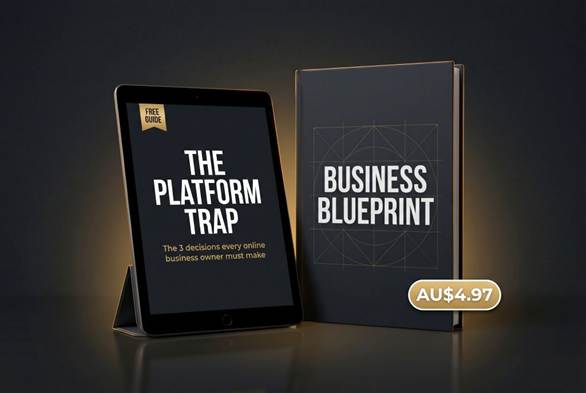
The Business Blueprint is the complete system I built after losing AU$8.49 million.
It covers:
How to audit your current business for platform dependency (most people are shocked by what they find)
The exact infrastructure stack I use to make sure my business lives on my terms, not the platform’s
How to document your business so it can run without you and be valued by someone else
The framework for turning what you currently have into something that qualifies as a real, sellable asset
The decision-making process I now run every time I add a new tool, platform, or revenue stream
The Business Blueprint is AU$4.97.
Not AU$497. Not AU$47. Four dollars and ninety-seven cents.
I priced it that way deliberately. Because the decision to pay AU$4.97 for a system that protects everything you’re building is exactly the kind of decision that separates the people who build real businesses from the people who stay stuck on the platform treadmill.
It is not a price. It is a filter.
Here’s what to do now.
Enter your email below. I’ll send you The Platform Trap guide immediately.
Read it. It will take you about 15 minutes.

And if you want to go all the way, the Business Blueprint will be waiting for you at the end, for AU$4.97.
But start with the free guide.
Because once you understand the three decisions, you will never look at your online business the same way again.
And that is exactly where the real work begins.
Leo Hokkanen, also known as Tutorman
Helping people to help themselves and freeing the world!
P.S. Every week you spend building on top of a platform you don’t own is another week the risk compounds. The platform is not waiting. The algorithm is not waiting. The terms of service update is not waiting. The guide is free. The decision to read it takes three seconds.
Enter your email. Get The Platform Trap. Make the three decisions.
The rest of this year could look very different from the last one.